
How to Pack a Kitchen Without Breaking Anything
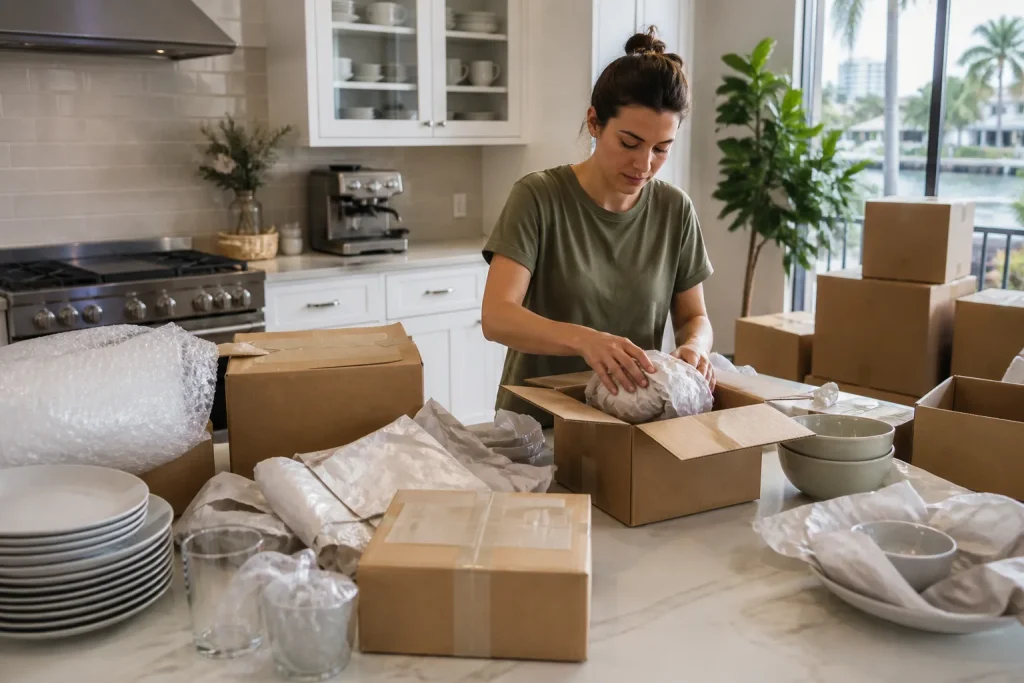
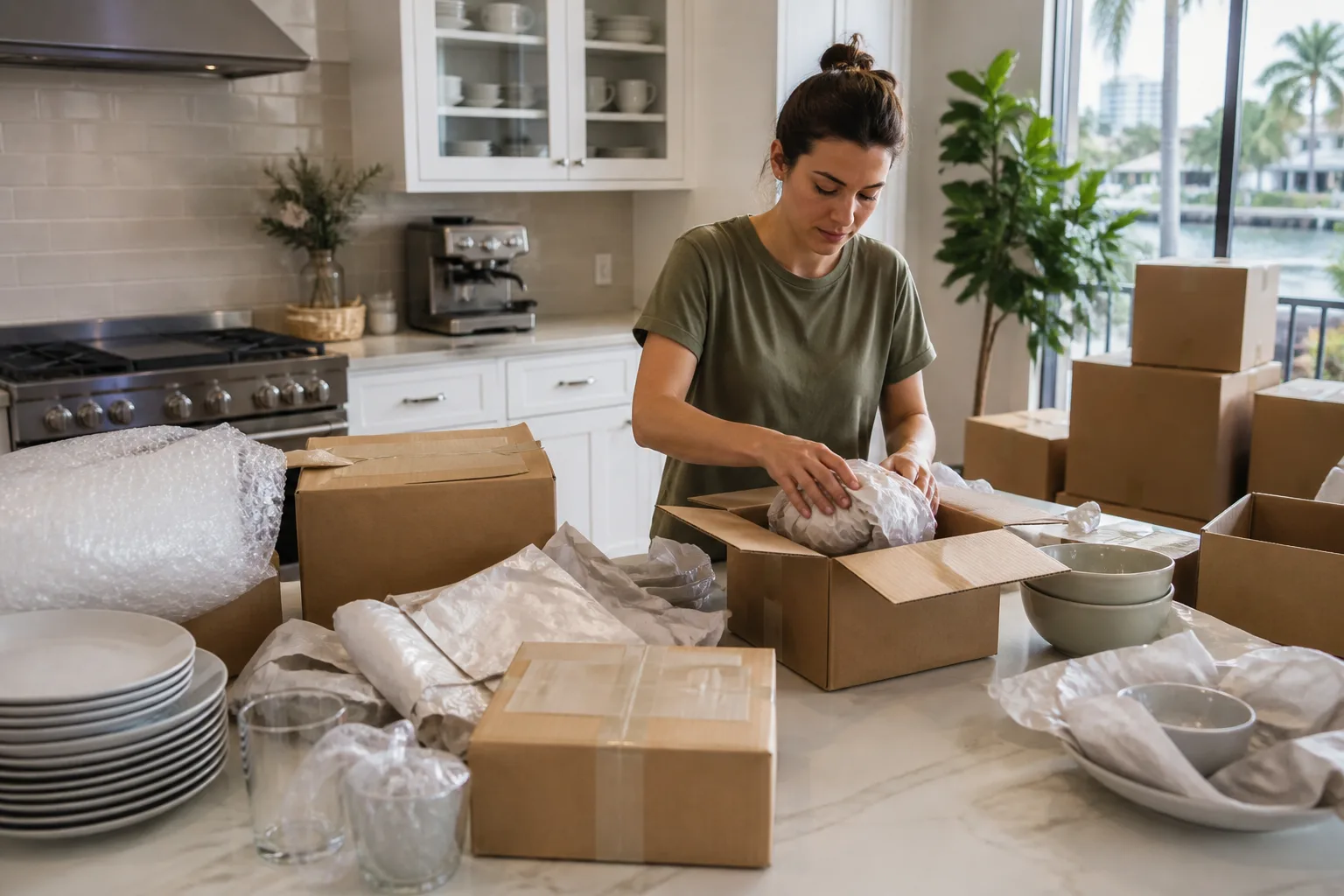
Packing a kitchen without breaking anything means working from the inside out: wrap each item individually, cushion every void, and never let weight rest on handles, spouts, or lids. Start with a single cabinet, finish it completely, then move to the next - partial packing leads to half-empty boxes that collapse in transit. If you’d rather not handle it yourself, Milestone Moving Co. packs kitchens daily across Hollywood and South Florida; call (855) 890-3455 for a free estimate.
Here’s a number that stops people cold: the average kitchen holds 150-200 individual items, and most breakage happens not from dropping the box, but from items touching each other inside it. We’ve unpacked boxes in Hollywood condos where every glass survived a three-story walk-up, and others where a single poorly packed dish box destroyed six plates on a five-mile local move. The difference is technique, not luck.
What Supplies You’ll Actually Need
Skip the newspaper for anything you eat off - the ink transfers and the paper offers almost no shock absorption. We use Uline dish packs and Milwaukee packing tape on every job, but the same results come from any sturdy materials used correctly.
Here’s what we stock on our trucks for a typical family kitchen:
- Dish barrels (5.2 cubic feet) - thicker walls than standard boxes, worth the extra cost for plates and glasses
- Packing paper, unprinted (15-20 lbs. per kitchen) - crumple it for cushioning, wrap with it for surface protection
- Bubble wrap (3/16″ for glasses, 1/2″ for small appliances)
- Cell kits (divided cardboard inserts) - one per wine glass, one per coffee mug; non-negotiable for stemware
- Permanent markers and “FRAGILE / THIS SIDE UP” labels
- Plastic wrap or large zip bags - for spice jars, opened containers, utensil drawers
One mistake we see constantly in Hollywood rentals: people grab free boxes from behind grocery stores. Those boxes are designed for single-use shipping, not stacking in a moving truck. They crush, they tear at the handles, and they dump your grandmother’s china on the driveway. Spend the forty dollars on proper boxes.
How to Pack Plates So They Survive
Plates break when weight concentrates on a single point, usually another plate’s rim pressing into its center. The fix is vertical packing, not horizontal stacking.
- Lay a stack of packing paper on the counter. Center one plate, fold one corner over, then the next, rotating the plate until it’s fully wrapped. Use two sheets for porcelain or anything over 10 inches.
- Stand plates on their edges in the box, like records in a crate. Never lay them flat - the bottom plate carries all the weight.
- Place a layer of crumpled paper between every third plate for shock absorption.
- Fill all void space with tightly crumpled paper. A box that rattles is a box that breaks.
- Label the top: “PLATES - HEAVY / THIS SIDE UP.”
We learned this the hard way on a job over in Hollywood Hills about fifteen years ago. Customer had packed her own plates flat, twelve high, with a single sheet of newspaper between each. The box sat in the truck for maybe twenty minutes before a turn shifted the load. Bottom plate cracked, weight redistributed, cascade failure - seven plates gone, and she was serving Thanksgiving on paper for two years. Vertical packing, void fill, proper box. Three rules, zero breakage since.
Glasses, Mugs, and Stemware
These are the items that look fine when you close the box and arrive as glitter. The problem is handles and stems - stress concentrators that snap under vibration.
For mugs and tumblers: wrap each in two sheets of paper, tucking paper inside the hollow first, then wrapping the exterior. Pack them rim-down, never nested inside each other. Nested cups lock together in transit and crack as the box shifts.
For stemware: invest in cell kits. Each glass gets its own cardboard compartment, with the stem protected by additional paper wrapping. In twenty years of moving Hollywood homes, we’ve never seen stemware survive a move without cells if the truck hits a pothole on Sheridan Street.
One practical tip: pack glasses in smaller boxes than plates. A dish barrel full of glasses weighs too much to lift safely and creates bottom-crush on the lower items. Two lighter boxes beat one heavy one every time.
Small Appliances, Pots, and Pans
These are the easy items that people pack wrong by overthinking.
Pots and pans nest by size, separated by paper to prevent scratching. Lids travel vertically in their own paper wrapping, packed along the box edge, never laid flat where they can flex and crack. Cast iron gets its own small box - it’s too heavy for mixed packing and will destroy anything it contacts.
Small appliances (blenders, coffee makers, toasters) go back in original boxes if you saved them. If not, wrap the base in bubble wrap, wrap glass carafes or pitchers separately, and pack them with the heaviest component on the bottom. Remove all blades and pack them in labeled paper - finding a loose blender blade in a box of utensils is a memorable experience.
We moved a family last month from a kitchen near Young Circle who had kept every original box for fifteen years. Unusual, but her Cuisinart and KitchenAid arrived in Hollywood West looking like they’d never left the store. If you have the storage, keep the boxes. If not, proper wrapping works nearly as well.
Food, Spices, and the Pantry
Moving companies won’t transport opened food containers, and you shouldn’t want them to. A box of olive oil that leaks coats everything in a film that’s nearly impossible to clean.
Pack unopened non-perishables in small boxes - they’re heavier than they look. Tape spice jars shut, then seal them in zip bags. That cabinet of twelve nearly-identical spice jars? Label the bags. “Spices - kitchen” saves twenty minutes of sniff-testing at the new place.
Perishables get used, donated, or discarded. We’ve seen people try to move full freezers on local Hollywood moves; the ice cream becomes soup, the soup becomes a mess. Empty it. Defrost it. Clean it. Move it empty and dry.
When to Call a Professional Packer
Some kitchens justify professional packing, and the decision usually comes down to three factors: time, volume, and sentimental value.
If you’re working full-time through your move week, packing a kitchen properly takes twelve to fifteen hours you don’t have. If you’re downsizing from a large family kitchen to a Hollywood condo, the volume of decisions - keep, donate, pack, discard - overwhelms most people. And if your cabinets hold wedding china, inherited crystal, or anything irreplaceable, professional packing with full-value protection is straightforward insurance.
Milestone Moving Co. packs kitchens as standalone service or as part of full-service moves. Everything we pack is covered by our Move-Right Guarantee: a binding written quote after a real in-home or video survey, full-value protection on items we handle, and our 90-Day Done Right Promise - if anything isn’t right after delivery, one call brings a crew or a check, not a claim form that disappears.
Related services in Hollywood: Milestone Moving Co. home for full moving and storage solutions, or call (855) 890-3455 to schedule a free estimate.
Key Takeaways
- Wrap every item individually - contact between items causes most breakage
- Pack plates vertically on their edges, never stacked flat
- Use cell kits for all stemware - the cost is trivial compared to replacement
- Fill every void with crumpled paper; silence in the box means safety
- Keep boxes under 40 lbs. for safe lifting and structural integrity
- Original appliance boxes are worth the closet space if you have it
The Bottom Line
A kitchen packed well arrives intact. A kitchen packed poorly arrives as a donation pile and a shopping list. The techniques above work - we’ve used them on thousands of moves across Hollywood and South Florida since 2006. The investment is time and materials, maybe a hundred dollars in proper supplies for a typical family kitchen.
If you’re in Hollywood or anywhere in Broward County and would rather spend that time on other priorities, Milestone Moving Co. offers free in-home and video estimates. We’ll survey your kitchen, give you a binding written quote that doesn’t change on move day, and pack it with the same materials and methods we’ve described here. Call (855) 890-3455 or book online. Current offer: $250 off moves over $2,500, plus free wardrobe boxes on every full-service move.
Frequently Asked Questions
Pack it two to three days before move day, not first and not last. You’ll still need some utensils and a few dishes until the final hours, but starting too late leads to rushed packing and breakage. Call (855) 890-3455 if you need professional packers to handle the timeline.
Towels work for larger items like serving bowls, but they’re too bulky for glasses and leave gaps that allow shifting. We use packing paper on every Milestone job because it’s consistent, clean, and fills voids precisely. Towels are a backup, not a replacement.
Professional kitchen packing typically runs $300-$600 for a standard family kitchen, depending on cabinet count and item volume. Milestone provides a binding written quote after a real survey - the number doesn’t change on move day. Call (855) 890-3455 for an exact figure on your kitchen.
Overpacking boxes and underfilling voids. A box that’s too heavy crushes from below; a box with empty space lets contents collide. Both cause breakage that proper technique prevents entirely. If you’re unsure, professional packing with full-value coverage eliminates the risk.
Written by Dale Whitmore, Owner & Crew Chief, Milestone Moving Co. at Milestone Moving Co., serving Hollywood since 2006.
Need Moving Help?
Call Milestone Moving Co. - licensed & insured, available 24/7 in Hollywood.
(855) 890-3455