
Moving a Piano: What Actually Goes Wrong
Piano moving fails most often because owners underestimate the weight distribution, skip proper equipment, or trust regular movers without piano-specific training. A standard upright runs 300-500 pounds with 80 percent of that mass in the cast-iron harp, making it tip-heavy and unpredictable on stairs. In our 20 years handling pianos across Hollywood and South Florida, we’ve seen the same preventable damage repeat itself - cracked soundboards, crushed walls, and movers with back injuries who won’t be finishing the job.
If you’re weighing a DIY move against calling trained help, you can reach us at (855) 890-3455 for a free in-home or video estimate. No obligation, and we’ll tell you honestly whether your situation is manageable or not worth the risk.
Why Pianos Are Nothing Like Moving a Dresser
The first mistake is assuming a piano is just a heavy box. A 400-pound upright isn’t 400 pounds spread evenly - it’s 320 pounds in the harp, 80 pounds everywhere else, and all of it riding on four small casters never designed for transport.
Those casters sink into carpet, catch on thresholds, and snap off under lateral stress. We’ve replaced more broken casters in Hollywood homes than I can count, usually after someone rolled an upright across a tile joint and watched it tilt. The legs on grand pianos are worse - they’re decorative dowels, not structural supports, and they shear off if you lift from the wrong point.
Pianos also don’t forgive cornering errors. A standard door in Hollywood’s older homes like those in the historic district is 28-30 inches wide. An upright piano is 24-25 inches deep, but add the pedal lyre and you’re at 27. That leaves no room for error, no room for the mover’s hands, and definitely no room for the piano to shift. We’ve extracted stuck pianos from stairwells in Lake Forest and Beverly Hills where the crew tried to pivot without measuring first.
What goes wrong here:
- Underestimating the center of gravity and watching the piano tip backward on stairs
- Trusting the original casters to roll across anything rougher than hardwood
- Attempting tight turns without removing doors or planning the angle of approach
- Using standard moving straps that compress the case and damage the soundboard
The Equipment Most People Don’t Own
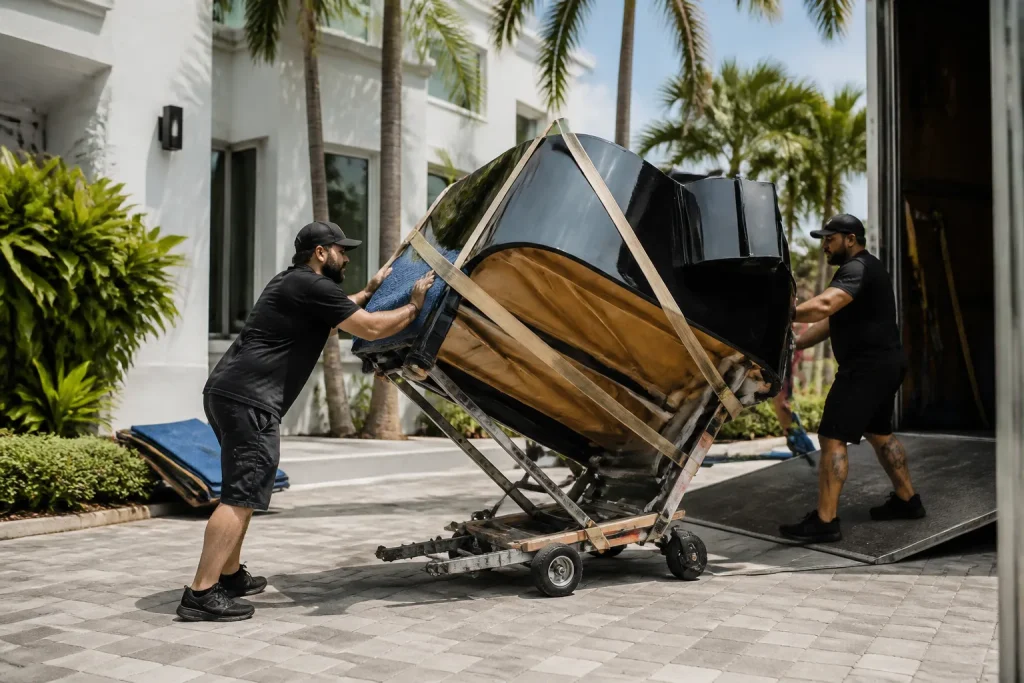
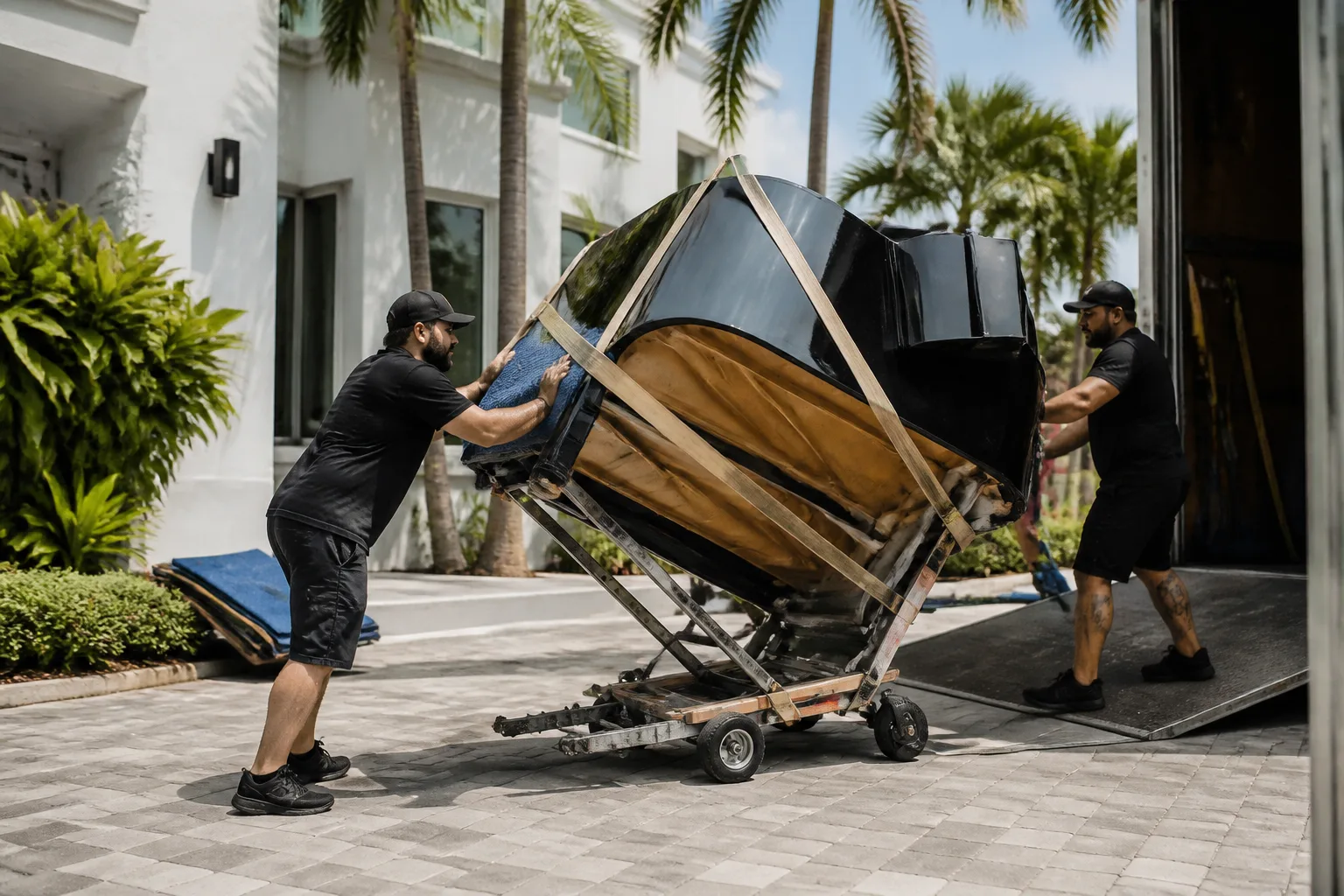
A proper piano move requires a piano board (a padded, rigid skid with locking straps), a heavy-duty dolly with pneumatic tires, at least two piano-specific straps, and often a stair-climbing attachment or crane service for multi-story jobs. We’ve invested in this equipment because a Uline furniture dolly and a ratchet strap from Budget Truck Rental won’t cut it.
The piano board matters more than people realize. It distributes weight across the instrument’s structural frame, not the lid or case panels. Without it, pressure concentrates on weak points. We once inspected a Steinway in Hollywood Hills where a previous mover had strapped across the lid; the lid had separated from the case and the hinge mortises were splintered. The repair cost exceeded what a professional move would have run.
Pneumatic dollies handle South Florida’s cracked sidewalks, paver driveways, and the uneven transitions common in Hollywood’s mid-century ranch homes. Hard wheels vibrate through the frame and throw tuning out - sometimes permanently if the pin block loosens. And stair-climbing equipment isn’t a luxury on Hollywood’s split-level homes; it’s the difference between controlled descent and a runaway 500-pound weight.
When to call a pro: If your route includes stairs, tight turns, gravel or grass transitions, or if the piano is a grand over 5 feet long. The cost of professional piano moving in Hollywood typically runs $350-$800 for local transport, depending on access difficulty. That’s less than most soundboard repairs.
Related services in Hollywood: Our Milestone Moving Co. home page covers our full piano and specialty moving services, including crane-assisted moves for high-rise buildings along Hollywood Beach.
What Gets Damaged When Things Go Wrong
The piano isn’t the only casualty. We’ve repaired drywall in Hollywood condos, refinished hardwood where casters gouged the grain, and replaced a custom wrought-iron railing that a DIY team bent trying to lever an upright around a landing.
Internal piano damage is harder to spot immediately. A jarred action - the mechanical linkage between keys and hammers - develops dead notes or double-striking weeks later. The soundboard, a thin spruce panel under 300+ pounds of string tension, cracks if the piano torques during a drop. Pin blocks, which hold the tuning pins at precise angles, loosen if the piano is bounced or stored on its side in humidity.
Hollywood’s climate compounds this. We see 75-85 percent humidity much of the year, and pianos absorb moisture through their soundboards. A piano moved in high humidity and immediately placed against an exterior wall can swell, stick, and go out of tune within days. We schedule piano moves to avoid the worst humidity when possible, and we acclimate the instrument in the new space before final positioning.
Common damage patterns:
- Cosmetic: Case scratches, leg breaks, pedal lyre damage - usually from inadequate padding or wrong lift points
- Mechanical: Action misalignment, broken hammer shanks, detached keybed - from vibration or impact
- Structural: Soundboard cracks, pin block loosening, bridge separation - from drops, torque, or humidity shock
- Environmental: Mold in the action, rusted strings, veneer delamination - from uncontrolled storage or transport conditions
The Human Cost: Injuries That Don’t Heal Quickly
This is the part most blog posts skip. A piano’s weight isn’t the problem - its momentum is. On a stair, 400 pounds at a 5-degree tilt generates enough force to pin a person against a wall or take out knees and ankles on the lower crew member.
We’ve seen herniated discs from attempted team lifts where one person lost grip. We’ve seen crushed fingers when a piano board slipped on a threshold. In our early years, before we standardized our equipment, one of our crew took a piano corner to the ribs on a Hollywood Lakes job - three weeks out, and he was one of our best. That’s when we stopped improvising and started requiring the full rig on every piano move.
Professional piano movers work in teams of three or four, not two. We use command calls - “ready, lift, step, set” - so everyone moves together. We never carry a piano more than a few feet without it being on a board or dolly. And we never, ever, let a customer “just help a little” on the stairs. Insurance doesn’t cover it, and friendship doesn’t survive a dropped Baldwin.
Our crews are background-checked, uniformed, and trained to headquarters standards - not day labor sourced from a text message. One crew, start to finish, with the same people who loaded the truck unloading it. That’s not just accountability; it’s safety continuity.
Storage and Climate: The Hidden Failure Point
Maybe you’re not moving the piano today - you’re storing it during a renovation or between homes. This is where more pianos die than in transport.
A non-climate-controlled unit in Hollywood will swing from 65°F in January to 95°F in August, with humidity following. That expansion and contraction cycles the soundboard until it cracks. We’ve rescued pianos from storage facilities near I-95 where the owner “just needed a month” and left it for fourteen. The strings were rusted to the tuning pins, the action was swollen shut, and the case veneer had bubbled off in sheets.
If you must store, climate control isn’t optional - it’s 55-70°F and 40-50 percent humidity, period. The piano stands on its feet, never on its side or back. It’s covered with breathable cloth, not plastic, and it’s away from exterior walls and direct sunlight. We offer climate-controlled moving and storage solutions for exactly this scenario, with monthly condition checks and delivery scheduling when you’re ready.
Even short-term storage between closing dates needs planning. We see this constantly in Hollywood’s competitive real estate market, where closing dates don’t align and the piano sits in a garage for two weeks. Two weeks in a South Florida garage in July is enough to warp a soundboard.
When the “Savings” Cost More Than the Move
We get calls every month from people who hired a general mover or rounded up friends, and now something’s wrong. The piano won’t hold tune. There’s a buzz on the bass strings. The sustain pedal doesn’t work. Sometimes the damage is immediate and visible - a cracked leg, a crushed corner. Sometimes it shows up at the technician’s six-month tuning.
The economics are straightforward. Professional piano moving in Hollywood runs roughly what we quoted above. A soundboard replacement starts at $3,000 and often isn’t economically viable on uprights. Action regulation runs $500-$1,500. And that’s if the piano is worth repairing - many modern uprights aren’t.
We pulled a console piano out of a garage over in Emerald Hills last month where the owner’s nephew and two friends had attempted the move. They got it to the garage before the casters caught on the expansion joint and the piano tipped onto its face. The pin block was cracked, the music rack was splintered, and the internal mechanism had shifted enough that twelve keys were dead. The piano was a total loss. The “free” move cost them a family instrument and the embarrassment of explaining it at Thanksgiving.
Our pricing is binding after a real in-person or video survey. The number we quote is the number you pay - not a penny more on move day, not a surprise on the ramp. That’s the Move-Right Guarantee, and it’s been our standard since 2006.
Key Takeaways
- Pianos are tip-heavy, structurally fragile, and unforgiving of improvisation - not just “heavy furniture”
- Proper equipment (piano board, pneumatic dolly, specific straps) isn’t optional; household moving tools fail
- Hollywood’s humidity and older home layouts add variables that DIY plans rarely account for
- Internal damage often appears weeks later; the cost of repair frequently exceeds professional moving
- Injury risk to untrained helpers is real and severe, especially on stairs
- Storage requires climate control and correct positioning - garages and standard units destroy pianos
The Bottom Line
Piano moving goes wrong when people treat it like moving a heavy dresser with better sentimental value. It’s a specialized job requiring specific equipment, trained technique, and respect for what happens when 400 pounds of cast iron and spruce gets away from you. We’ve been handling pianos in Hollywood since 2006, from uprights in Lake Forest condos to concert grands in beachfront homes, and the pattern is always the same: the move that looks manageable from the couch rarely is.
If you’re in Hollywood or anywhere in South Florida and need your piano moved, stored, or just honestly evaluated for whether it’s worth the cost, Milestone Moving Co. offers free in-home and video estimates. Call (855) 890-3455 and you’ll reach a live person - before the move, during the move, and if anything needs attention after. The price we quote is the price you pay, backed by our 90-Day Done Right Promise. No subcontractor, no claim form that disappears, no surprises.
Frequently Asked Questions
Regular movers can transport a piano if they have piano-specific equipment and training, but most residential moving crews don’t. We’ve been called to fix jobs where general movers used standard furniture dollies and ratchet straps, resulting in case damage or internal mechanical issues. If the company doesn’t own piano boards, pneumatic dollies, and stair-climbing equipment, they’re not equipped for this work. Call (855) 890-3455 and we’ll tell you honestly whether your situation needs our piano crew or if your current mover is qualified.
Local piano moves in Hollywood typically range from $350 for a ground-floor upright to $800 or more for a grand piano requiring crane service or difficult stair access. The final price depends on piano type, access conditions, and distance. We provide a binding written quote after a real in-person or video survey - the number doesn’t change on move day. Call (855) 890-3455 for a free estimate.
Any piano move affects tuning slightly due to vibration and environmental changes, but proper technique minimizes this. The real problems come from improper handling - drops, excessive vibration from hard wheels, or humidity shock - which can damage the pin block or soundboard and cause permanent tuning instability. We schedule moves to avoid extreme humidity when possible and recommend waiting 2-3 weeks after delivery before tuning, allowing the piano to acclimate.
No - not in South Florida’s climate. Standard storage units experience temperature swings from 65°F to 95°F and humidity well above safe levels for wooden instruments. This cycles the soundboard and action until they crack, swell, or delaminate. Climate-controlled storage at 55-70°F and 40-50 percent humidity is essential. Our storage facilities maintain these conditions with monthly checks, and we deliver when you’re ready. Call (855) 890-3455 to discuss short- or long-term piano storage options.
Written by Dale Whitmore, Owner & Crew Chief, Milestone Moving Co. at Milestone Moving Co., serving Hollywood since 2006.
Need Moving Help?
Call Milestone Moving Co. - licensed & insured, available 24/7 in Hollywood.
(855) 890-3455