
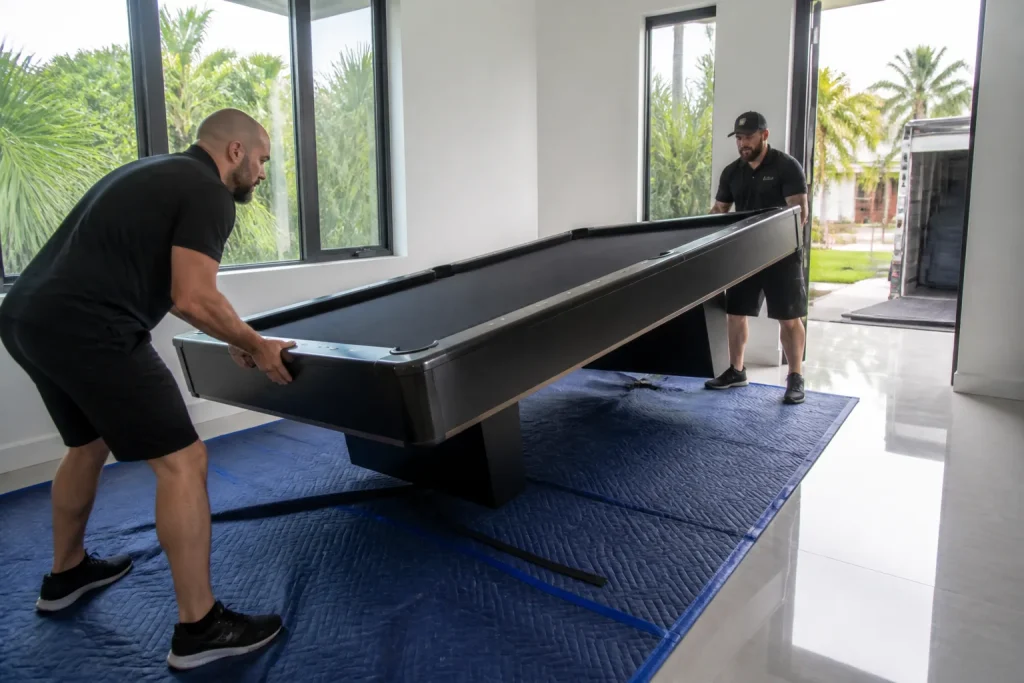
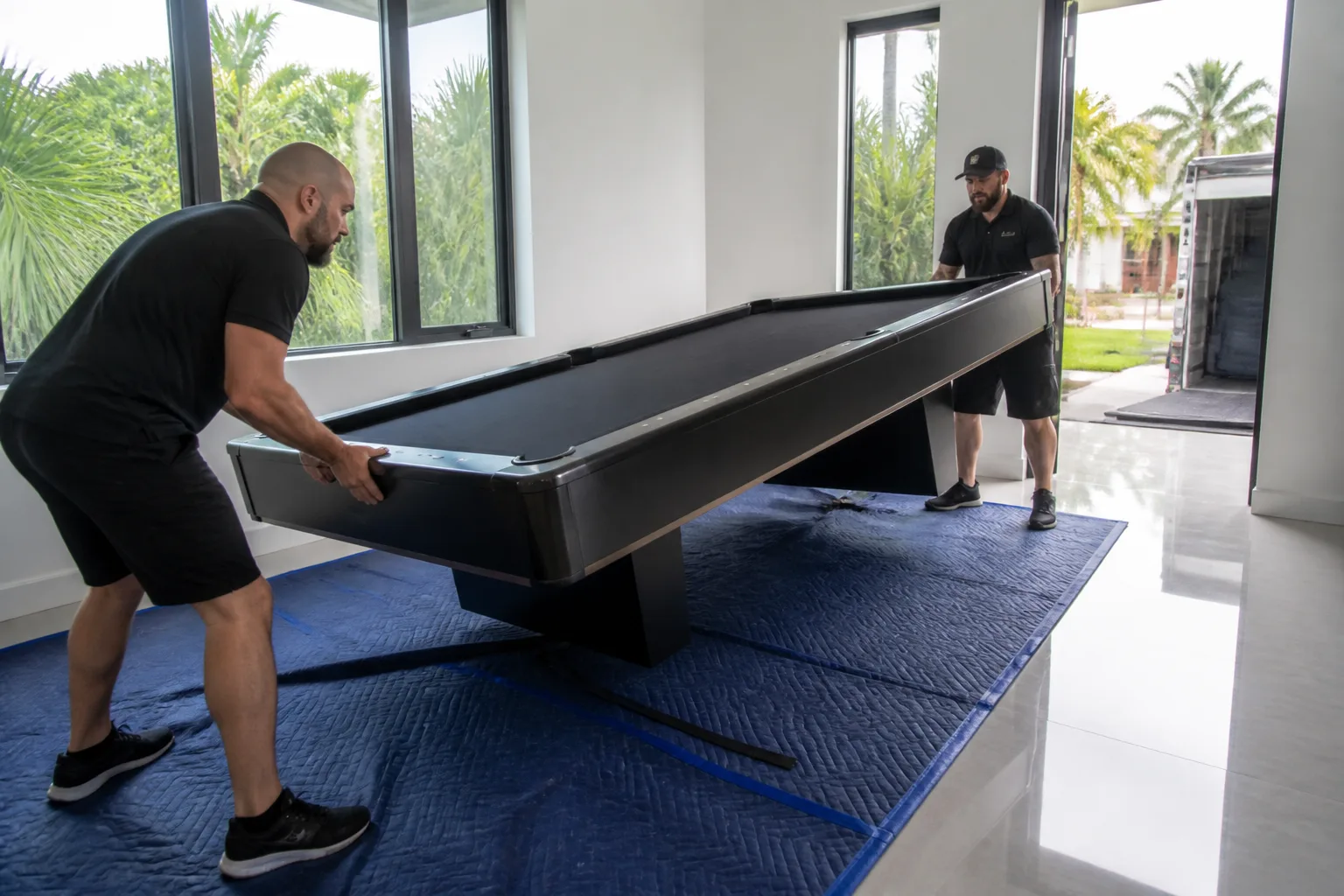
Moving a Pool Table the Right Way
A pool table weighs 700 to 1,000 pounds, has a three-piece slate bed that cracks if torqued wrong, and requires disassembly before any doorway will accept it. The right way means breaking it down systematically, protecting each component, and re-leveling at destination with a machinist’s level, not a smartphone app. If you’d rather not handle 400 pounds of slate or risk a $5,000 table, call Milestone Moving Co. at (855) 890-3455 for a free estimate.
We’ve been moving pool tables in Hollywood since 2006, and the calls we get usually start the same way: “We watched a YouTube video.” Then we drive out to a garage in Hollywood Hills or an apartment off Young Circle and find felt torn, slate chipped, or a frame that’s been twisted past repair. Here’s what actually works.
Why Pool Tables Aren’t Like Moving Other Furniture
Most heavy furniture is one solid piece. A pool table is a tension system. The slate bed, usually three slabs of Brazilian or Italian slate at one inch thick, sits on a wood frame that’s held in compression by the rails. Remove the bolts in the wrong order, or let the frame rack even slightly, and that compression releases unevenly. The slate cracks. The frame warps. The table becomes unplayable.
The felt is another vulnerability. It’s not carpet. It’s a directional wool-nylon blend, stretched to specific tension with a special stapling pattern. Peel it off carelessly and it tears at the staple line. Re-stretching costs $300 to $500, assuming the felt survives removal at all.
In Hollywood’s humidity, we’ve seen a second problem: wood expansion. A table stored in a non-climate-controlled garage in West Lake or Emerald Hills can swell enough that the slate no longer seats flat. Moving it without checking this first means re-leveling that never quite holds.
Key components that need individual protection:
- Slate bed: Three pieces, each 200+ pounds, zero flex tolerance
- Frame and legs: Often solid hardwood, prone to corner damage
- Rails and pockets: Contain rubber cushions that degrade if dropped
- Felt: One-time stretch; removal usually means replacement
- Hardware: Specialty bolts and shims, easily lost, hard to replace
Tools and Supplies You’ll Actually Need
We’ve watched people try this with a cordless drill and a friend’s pickup. It never ends well. Here’s what the job actually requires:
- Staple puller and heavy-duty staple gun - for felt removal and reattachment
- Socket set with extensions - rail bolts are often recessed deep
- Moving blankets, 8+ - slate edges chip on contact with anything hard
- Plywood sheets or a slate crate - slate must be transported flat, never on edge
- Machinist’s level, 24-inch minimum - standard levels aren’t precise enough
- Shims and beeswax - for leveling seams between slate pieces
- At least three people - two for slate, one for spotting and padding
The slate crate matters more than people think. We built ours from Milwaukee tool chest crates we adapted years ago, and we still use that basic design. Each slate piece gets its own compartment, held vertical only during loading, never during transport. A piece of slate left flat in a truck bed will fracture from road vibration. A piece stored on edge without support will snap under its own weight.
In Hollywood, where summer rain hits hard and fast, we also keep Uline plastic sheeting on every truck. A wrapped table in a sudden downpour between house and truck is the difference between a clean move and a total felt replacement.
Step-by-Step Disassembly
This is where the YouTube videos usually skip details that matter. We’ve refined this over hundreds of tables.
- 1
Remove the pockets. Usually six, held by screws or staples. Bag the hardware immediately.
- 2
Detach the rails. Work from the ends toward the middle, alternating sides. This keeps frame tension even. Label each rail’s position - they’re not interchangeable.
- 3
Strip the felt. Staples out carefully, working with the weave direction. If you’re reusing the felt, roll it don’t fold it.
- 4
Remove the slate. Three bolts per piece, typically. Support the center of each piece before the last bolt comes out. Slate has no handles. We use suction cups rated for 200+ pounds, or padded lifting straps.
- 5
Break down the frame. Legs off, frame separated if it’s a sectional design. Photograph the assembly before you start - your reference for reassembly.
We moved a table last month from a home in Hollywood Lakes where the owner had started this process, gotten the rails off, then realized the slate bolts were seized from salt air corrosion. We brought penetrating oil, impact drivers, and the patience to work them free without stripping the heads. That’s the kind of problem that turns a Saturday project into a three-weekend ordeal.
Transport: The Part Most People Get Wrong
Slate travels flat, period. In a Budget Truck Rental or any rental vehicle, this means building a level platform in the bed or cargo area. The slate pieces sit on moving blankets, with plywood beneath to distribute weight across the floor structure. Nothing stacks on top of slate. Nothing wedges against it.
The frame and legs ride separately, well-padded, with rails secured so they can’t shift. We’ve seen rails ruined because someone leaned them against the truck wall and a turn sent them sliding into the door track.
Temperature matters in South Florida. A closed truck in July can hit 140 degrees. The wood frame releases moisture, the glue in laminate joints softens, and rubber cushions degrade faster. We schedule pool table moves early morning when possible, and we never leave a disassembled table in a parked vehicle.
If you’re moving long-distance, the math changes. U-Pack containers work for the frame and accessories, but we’d never put slate in one without a custom crate. The vibration profile of intermodal shipping will find every weakness. For our long-distance moves from Hollywood, we either crate the slate ourselves or use dedicated moving equipment with air-ride suspension.
Reassembly and Leveling: Where Precision Pays
Reassembly is not disassembly in reverse. The frame goes down first, leveled roughly. Then slate pieces are placed, and the real work begins.
Each seam between slate pieces must be flat to within 0.005 inches. We use a straightedge and feeler gauges, then fill any gap with beeswax, leveled with a hot iron. Skip this step and you’ll feel the seam every time a ball rolls across it.
Full leveling requires the machinist’s level at multiple points across each slate piece, with shims under the frame as needed. In older Hollywood homes, especially in Hollywood Hills with their settled foundations, we’ve spent two hours on leveling alone. A table that’s close but not perfect is worse than one that’s obviously off - players adjust to visible problems, but subtle rolls steal games silently.
Felt reinstallation demands a clean, climate-stable space. We stretch to manufacturer spec, staple in the correct pattern, and trim with a sharp blade. New felt runs $200 to $400 for standard grades, up to $600 for tournament worsted cloth. Factor this into your decision about DIY versus professional handling.
When to Call a Professional
Call us if the table is slate (not MDF - if it’s under $1,500 new, it might be), if the move involves stairs or tight turns, if you don’t have the tools listed above, or if the table has any value beyond pure function. We’ve rescued DIY attempts from throughout Broward County, and the pattern is consistent: the attempt costs more than the original quote would have, plus the stress of damaged property.
Our Milestone Moving Co. home page lists our full service range. For pool tables specifically, we offer disassembly, crating, transport, and re-leveling as a single quoted service. The number we write down after surveying your home is the number you pay - no ramp surprise, no “it was heavier than expected” add-on.
Related services in Hollywood: We also handle piano and specialty moving for concert grands and antique pieces, plus standard local and long-distance residential moves with the same binding-quote structure.
The Bottom Line
Moving a pool table right means respecting the engineering: systematic disassembly, flat slate transport, precise re-leveling, and felt handled as the wear surface it is. The tools cost $300 to acquire, the learning curve is steep, and a single mistake with slate is irreversible.
Key takeaways:
- Slate is fragile under its own weight - transport flat, pad completely, never stack
- Frame tension matters during disassembly - remove rails in alternating pattern
- Leveling to playability standard requires precision tools, not guesswork
- Humidity and heat in Hollywood accelerate problems - plan timing and protection
- Professional handling includes insurance against the mistakes that total a table
If you’re in Hollywood and facing a pool table move, Milestone Moving Co. offers free in-home or video estimates. The quote we write down is binding. Our crew shows up in uniform, on our payroll, with the right equipment. Call (855) 890-3455 to schedule.
Frequently Asked Questions
Professional pool table moving in Hollywood typically runs $400 to $800 for local moves, depending on table size, stair access, and whether felt replacement is needed. Long-distance or crated slate moves cost more. Milestone Moving Co. provides a binding written quote after a real survey - call (855) 890-3455 for an exact number.
No, not without high risk of damage. The slate bed, frame rails, and legs are designed as a tension system that won’t fit through standard doorways intact. Attempting to move a pool table in one piece usually results in torn felt, cracked slate, or a twisted frame. Disassembly is the only safe method.
Disassembly, transport, and reassembly with leveling typically takes four to six hours for a standard home. Complex stair access, long carries, or significant re-leveling needs can extend this. We schedule a named arrival window and call before we knock, so you’re not waiting open-ended.
Usually yes, if the original felt is more than a few years old or was originally installed with adhesive rather than staples. Stapled felt can sometimes be reused if removed carefully, but the stretch tension rarely matches exactly after removal. We include felt replacement options in our quotes when appropriate.
Written by Dale Whitmore, Owner & Crew Chief, Milestone Moving Co., serving Hollywood since 2006.
Need Moving Help?
Call Milestone Moving Co. - licensed & insured, available 24/7 in Hollywood.
(855) 890-3455